 enEnglisch


WEBINAR · ON DEMAND
Beyond MES: Closing pharma’s execution gap to accelerate release
How to close the gap between MES and daily shop-floor operations – and why that is a key lever to speed up batch release.
On demand · 48 min · English subtitles
Speaker: Thomas Halfmann, Seqonis
Free to watch – no registration

What you'll learn
Where the execution gap comes from
Why MES alone doesn’t close the gap between planning, quality and the shop floor.
Speed up batch release
What really blocks a batch from release – and how to manage release as one flow across production, QC and QA.
Connect teams and data
How an Intelligent Operations Platform links people, systems and decisions in real time.
Real-life examples
From a delayed line restart to a blocked batch release: where hours get lost every day.
Watch the recording
48 minutes · English with subtitles · Full transcript below
FREE ADD-ON
Get the slides
48-min webinar
free of charge

Trusted by Leading Pharma Companies Worldwide




Watch the recording
48 minutes · English with subtitles · Full transcript below
KEY TAKEAWAYS
Why doesn’t MES alone speed up batch release?
- MES digitized batch execution – but it was never built to run the whole factory.
- Most delays happen between systems: open deviations, unclear handovers, missing context.
- An Intelligent Operations Platform connects people, data and workflows across MES, LIMS and QMS.
- The result: faster decisions, fewer delays and a faster batch release.
The webinar to read
Prefer reading? The full webinar, chapter by chapter.
From MES to performance (1:38)
MES has been part of my professional life for twenty-five years. In the early 2000s, I was responsible for the global rollout of paperless manufacturing at Novartis: electronic batch records, review by exception, moving pharma manufacturing from paper to digital on a global scale. Since then, I’ve implemented MES, advised manufacturers, chaired the MES conference for more than ten years, and today I chair the ISPE Pharma MES Committee.
So I’m probably one of the last people who would argue that MES is not important. It is essential. But MES solved one key problem – digitalizing the batch and its journey. It did not solve the entire performance problem. Operations leaders keep asking me: How do we move from digitally executing manufacturing to improving the performance of the entire operation?
Factories are expected to deliver more output, higher productivity and faster release – with the same assets, the same workforce and increasingly complex processes. For twenty years, digitalization meant digitalizing the batch record. The question today is: How do we deliver measurable performance improvement every day, with the factory we already have?
Manufacturing is squeezed from several directions at once: cost pressure, the need for more throughput with the same assets, experienced people leaving and being hard to replace, growing complexity – and an expectation of speed. Not just producing faster, but responding faster when something changes. Batches are getting smaller, so lines must change over faster and run more batches than ever.
Every morning, this becomes very practical: Can we execute today’s plan? What is putting it at risk? Will something today cause a delay tomorrow? This is where performance is won or lost – not in a new strategy or KPI report, but in the many decisions made during the day. So why, despite all our technology, do we still lose performance on the shop floor every day?
What MES does – and what it doesn’t (9:31)
MES has become the digital backbone of pharmaceutical manufacturing. It replaced paper with electronic records, provides traceability across materials, equipment, operators and process steps, standardizes workflows, gives real-time visibility and delivers a reliable batch record that eases review and release.
So MES is not outdated – quite the opposite. I’m not suggesting we move away from it, but that we build on what it has made possible. To do that, we need to distinguish between digitally executing a manufacturing process – what MES was designed for – and operationally running the entire plant. That’s where the next performance opportunity begins.
Transactional systems like ERP, MES and automation are essential, but they are not the whole operation. Beyond executing orders and recipes, there is the operational reality: priorities, problems, dependencies, decisions, actions, follow-up and continuous improvement. It involves production, QC, QA, engineering, maintenance, supply chain, operational excellence and leadership.
This is not a failure of MES – it’s a different type of work MES was never designed for. MES knows everything about the batch. But running the factory requires context beyond the individual transaction. And that’s exactly where a significant part of performance is created – or lost.
Where performance gets lost (15:28)
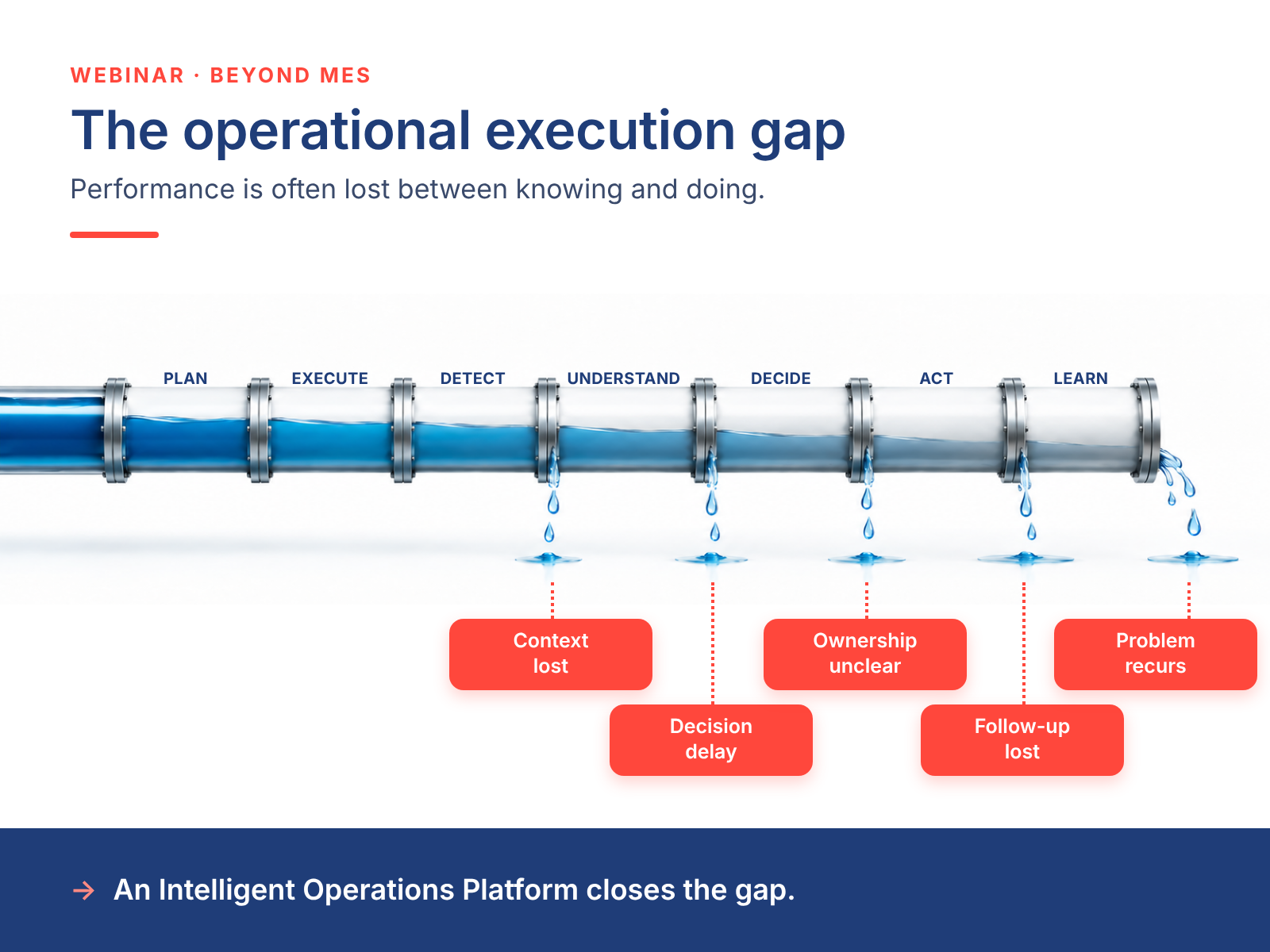
We plan, execute and detect deviations – a delay, an equipment issue. Then we need to understand what it means: Is the plan at risk? Do quality, engineering or maintenance need to be involved? Does it affect tomorrow’s batch? Then we decide, act and learn.
On a slide, this looks simple. In reality, we lose time between every step. The information sits in our systems, but the context is elsewhere – often in an experienced operator’s head. A problem is visible, but nobody feels responsible. An action is taken, but nobody checks whether it was completed. And next week, the same problem returns.
None of this means MES, ERP or LIMS have failed. The performance loss happens between the systems – in meetings, phone calls and follow-ups. This is what I call the operational execution gap.
The hidden factory
The visible factory is what we see in our systems: MES, ERP, LIMS. But there is a second, hidden factory: people constantly searching for information, trying to understand what happened in the last shift, calling quality for a decision, coordinating production, engineering and maintenance, waiting for answers to calls, emails and Teams messages.
This hidden factory consumes time every single day. The biggest performance opportunity is not adding another system – it is making the hidden factory visible, and then manageable.
Example: the delayed line restart
The plan says the line restarts at 2 p.m. An intervention was completed at 10:30, so for maintenance and engineering everything is solved. Production waits for confirmation and assumes engineering is coordinating with quality, which needs to do an assessment first. Every function does its job – but nobody sees the whole picture. Production waits on engineering, engineering waits on quality, and the assessment hasn’t even been assigned.
At the 2 p.m. tier meeting, the missing dependency finally becomes visible. The line starts at 4:40 p.m. instead – two hours and forty minutes lost to unclear dependencies and delayed decisions. This happens on the shop floor every day.
The Intelligent Operations Platform (23:30)
What’s missing is not another system of record or dashboard, and nothing that replaces MES, ERP or LIMS. It is an operational layer between the systems and functions that provides real-time visibility of what is actually happening. This is the Intelligent Operations Platform (IOP): it connects people and systems with operational context to coordinate execution and continuously improve performance.
MES executes the manufacturing process; an IOP orchestrates manufacturing operations. The two are complementary. Systems of record like ERP, MES, LIMS and QMS tell us what happened. An IOP is a system of action: it answers what matters right now, what needs attention first and what is blocking today’s plan – and helps us decide what happens next.
Use cases in practice (25:59)
Today’s plan at risk. At 7:30, everything looks fine – but line 4 has two unresolved dependencies: a pending QA approval and an open changeover action. Neither has stopped the line yet. If nobody connects them to today’s plan, we discover the problem at 2 p.m. An IOP changes the question from „What happened yesterday?“ to „What is threatening today’s output?“
Decision latency. At 10:15, the team spots an unexpected yield anomaly. Meetings, emails and calls follow. The time between detecting the issue and committing to an action is decision latency. With an IOP, batch and process context is already there, similar past events are visible, and an owner and next action can be assigned right away.
Batch release. Manufacturing and the production review are complete – but a QC result is blocking release, and QA review hasn’t started. Each system controls its own tasks perfectly, but what is stopping this batch from being released? An IOP makes the entire release flow visible and manageable – as one flow instead of a collection of departmental tasks.
Daily management. In tier meetings, we review yesterday, discuss red flags and assign actions. But afterwards: Does the action stay connected to the event that caused it? Can everyone see who owns it? Is it followed up? And if the problem returns, do we recognize it? With an IOP, a performance signal leads to context, context to priority, priority to an accountable action – which is followed up until it is effective. Performance management happens continuously, not just in the meeting, and nobody has to reconstruct information that already exists in the systems.
Operational memory. One of the most frustrating sentences in production is: „We had that problem before.“ An IOP connects events with their context, the actions taken and their outcomes. Knowledge that people usually carry in their heads becomes explicit, tested knowledge for the whole organization.
Conclusion (35:29)
ERP, MES, LIMS and QMS are essential, but they are not enough for daily operational orchestration. The IOP connects people with each other and with the data from these systems. It adds context, helps prioritize, decide and act, and drives continuous improvement – across all departments involved in running a plant, not just in manufacturing a batch.
It doesn’t replace the systems of record. It moves us from siloed information to shared operational context, from dashboards to coordinated execution, and from delays to faster action.
With ERP, MES, LIMS, QMS and automation, we have built a digital factory. But today, leadership expects more output, higher productivity, better throughput, greater reliability and faster response to problems. The answer isn’t another system of record. The remaining performance opportunity sits between the systems and between the functions.
MES made manufacturing execution digital. The Intelligent Operations Platform connects the operations around that execution. Ultimately, manufacturing performance is created when information becomes coordinated action.
Questions from the audience (38:25)
Do you need an MES before implementing an Intelligent Operations Platform?
No. The delays and performance losses we discussed happen with or without an MES. They just become more noticeable once an MES is in place and people ask why it doesn’t solve them. An MES is not a prerequisite for an IOP.
We’re exploring how AI could help us on the shop floor. Which IOP use case would you start with?
One obvious starting point is smart search – quickly finding problems that occurred a week or three months ago. A step further is AI-supported problem solving: identifying patterns in recurring problems, seeing how they were solved and supporting root cause analysis. I see that as one of the most important AI use cases in operations.
How can an IOP fit into a landscape with scattered OEE solutions?
The typical consulting answer: it depends on the landscape. An IOP has a modular architecture, so not everything has to be implemented within it. It includes an OEE component, but it can also integrate seamlessly with the OEE tools you already use.
What differentiates Seqonis from other providers?
Our industry focus. Seqonis isn’t a generic IT tool for operational excellence designed for every industry. It was built specifically for the process industries – above all pharma, and the closely related chemical industry. The problems it solves are deeply rooted in pharmaceutical manufacturing.
How does an IOP handle GMP requirements? Can it be validated?
Software can be validated – the question is whether it needs to be, which depends on its purpose. An IOP is not a system of record: raw data stays where it belongs, in the LIMS, MES, ERP, data lake or historian. The IOP accesses that data to provide operational context for decisions. Capabilities that do handle GMP-relevant data, such as the electronic logbook in Seqonis, are of course validated. But there’s no need to validate what isn’t a system of record.
Closing: Thank you for attending. If you’d like to continue the discussion, reach out to us via email or LinkedIn, or meet us at one of our upcoming conferences and exhibitions.

YOUR SPEAKER
Thomas Halfmann
Smart Manufacturing Expert with 20+ years in pharma production, MES and digital transformation. At Novartis he led the global rollout of paperless manufacturing incl. electronic batch records and review by exception.
“The right platform is not the one with the longest feature list, but the one that creates value, fits your architecture and is ready for the future.”
Testimonials

Senior Vice President, Digital Manufacturing


Change Leader in Industrial Affairs at Sanofi


Senior Manager Strategic Transformation


NEXT STEP
See Seqonis in your own plant
Get a 30-minute demo tailored to your site and use cases.
Related resources
 WhitepaperGeneral TopicsPharmaceuticalFrom Strategic Understanding to an Informed Buying DecisionGuide to Intelligent Operations Platforms in Pharmaceutical ManufacturingWhitepaper
From Strategic Understanding to an Informed Buying Decision
Guide to Intelligent Operations Platforms in Pharmaceutical Manufacturing
 Case StudyBayer AGFrom 20 communication platforms to one"We consolidated with Seqonis around 20 communication platforms into one."Case Study
Florian Leinenkugel
"We consolidated with Seqonis around 20 communication platforms into one."


More Webinars
Expert sessions on MES, AI and smart manufacturing – on demand and live.